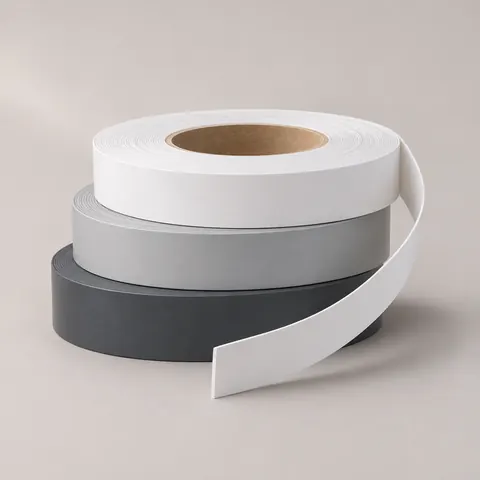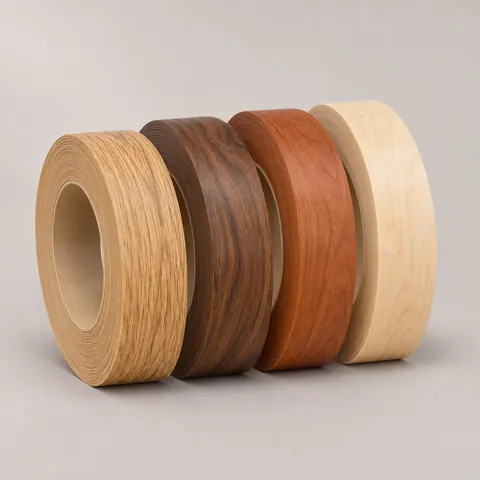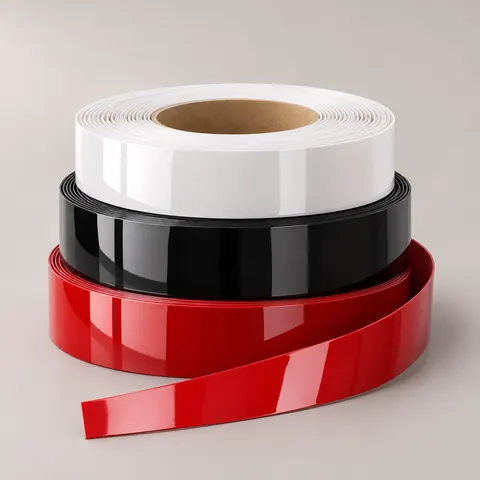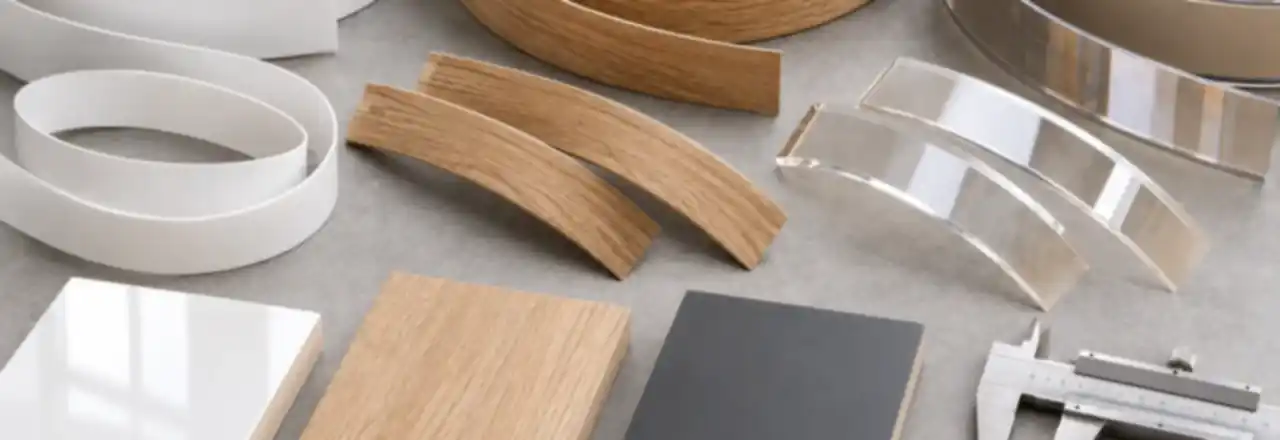
Choose PVC for the best price and the widest colour range, ABS when your market requires chlorine-free and recyclable materials or the furniture takes impact and heat, and acrylic (PMMA) for high gloss and 3D glass-effect edges on UV and acrylic doors.
The short answer
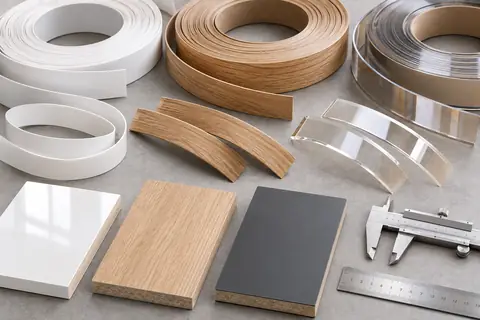
All three materials are thermoplastics extruded into strips, primed on the back and glued to the board with hot melt or fused with a laser. They differ in cost, hardness, environmental profile and how they look on different boards.
| Property | PVC | ABS | Acrylic (PMMA) |
|---|---|---|---|
| Relative price | Lowest | About 10–20% higher | About 30–60% higher |
| Contains chlorine | Yes | No | No |
| Surface hardness | Medium | Medium | High |
| Impact resistance in cold | Good | Very good | Fair |
| Best finish | Matt, wood grain, gloss | Matt, wood grain | High gloss, 3D two-tone |
| Typical thickness | 0.4–3 mm | 0.6–3 mm | 1–3 mm |
| Typical MOQ | 3,000 m | 3,000 m | 3,000–5,000 m |
When PVC is the right choice
PVC is the global default. It is flexible, easy to trim, holds printed decors well and costs the least per metre. For most cabinet carcasses, wardrobes and office furniture sold outside markets with chlorine restrictions, a well-made PVC edge banding is the best value.
Quality varies more than price suggests. Ask your supplier for the resin source, the anti-yellowing grade (look for SGS grade 4–5) and whether the trimmed radius stays white. Cheap PVC with high calcium carbonate filler turns chalky when trimmed.
When to pay more for ABS
ABS has no chlorine, so it burns without producing hydrochloric acid and is easier to recycle. Many European furniture brands and public tenders specify it. It is also tougher at low temperatures, which matters for school and office furniture that is moved and knocked.
ABS takes printing less readily than PVC, so very detailed wood grains can look slightly flatter. For solid colours and standard wood grains the difference is hard to see.
When acrylic is worth it
PMMA acrylic is clear and hard. Printed on the reverse, it gives a mirror surface whose colour cannot wear off. Co-extruded with a coloured layer it creates two-tone 3D edges, the thin glass-like line seen on premium gloss kitchen doors. If your door is high gloss UV or acrylic, a PVC edge rarely matches its depth.
Match the edge to the board
- Melamine MDF or chipboard: PVC or ABS, matt or wood grain, embossed for synchronized boards.
- High gloss UV or acrylic: high gloss PVC, mirror PMMA or two-tone 3D acrylic.
- Super matt UV, PET or acrylic: super matt PVC or laser edge banding.
- Kitchens and bathrooms: any of the above with PUR glue, or a laser edge for zero glue line.
Frequently asked questions
Is ABS edge banding better than PVC?
It is not better overall; it is different. ABS is chlorine-free and more impact resistant, while PVC is cheaper and prints better. Choose by market requirement and use.
Can I use the same glue for all three?
Yes, as long as each edge has a primer on the back. EVA, PO and PUR hot melts all bond to primed PVC, ABS and acrylic.